
When an argument arises, the most common response is to rapidly take a side that appears charitable and defend it with one’s life. People will take to social media, posting and using hateful speech to support a cause that they learned about a mere five minutes ago, claiming that anyone who does not align with their beliefs is morally wrong.
By drawing this harsh boundary, many people miss out on a whole other side of the story and leave behind those who choose to take a minute and think for themselves. This simple definition of “Good vs. Bad” has proven itself to be a confining and stifling idea that closes people off from a myriad of new ideas and instead limits them to just two. In today’s world, people have learned generational ideas, otherwise known as prejudices, that they believe are the sole way of life, and that anyone who may choose to think differently is immediately an enemy.
This can be coined as seeing the world in black and white, an outdated and very degrading custom.
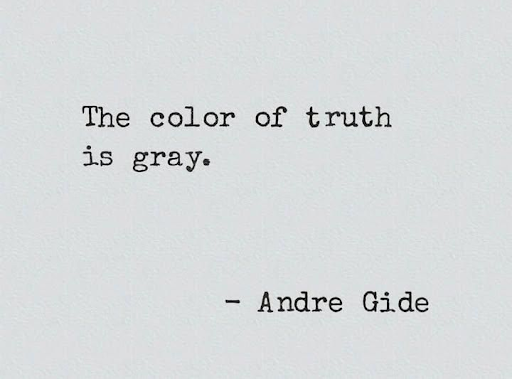
By seeing the world in terms of one side versus the other, or black and white, people don’t stop to consider the grey space, entertaining the notion that both sides may have something valuable to offer the world. The grey space can be referenced as the middle ground where ideas are not inherently good or bad; they are simply ideas. This goes beyond the common constraints of simplistic labels that deem one idea as good vs bad, and opens a world of new ideas that do not have to be categorized.
The idea of having a grey morality is often showcased in the idea of good vs. bad in modern fiction. Certain characters who have a complex character arc or moral alignment are labeled as “morally grey” because their choices may not always reflect the ones the audience may want or expect. These characters are often the most intricate and clever-minded additions to a story, as they provide another perspective on the issue and even defend both the good and bad sides of the conflict.
Looking at a problem through this neutral lens provides insight into the facts and reasons as to why either side has chosen their standpoint, not only hearing out both sides of the argument, but also allowing for the combination and compromise of ideas.
As we learn to navigate a world with an ever-changing political and social climate, there may be more to an issue than just its appearance on the surface, so adopting this diplomatic approach can help tear down division and repair relationships.
When world issues or disagreements reach the news or media, the story is often shifted to appeal to a certain group of people. The topic is described as a strict barrier with an uncrossable line, claiming that if you are not with them, you are against them.
This can taint the narrative with untrue facts or opinions from others to gain support for their personal agenda. By choosing to observe and respect both sides of the story, one can form an educated and equitable position that benefits the world.
This standpoint revolves around your personal opinion of what is right and how the outcome will not only affect you but also those around you. When formulating an opinion, it is important to utilize the grey space to consider how this standpoint could harm others from an unbiased or biased lens that can be misrepresented in the media.
In contrast, there are instances where one side may be inherently better than the other, but this concerns the concept of natural rights and the common well-being of others. Union vs. Confederate and Allied powers vs. Axis powers are all debates that sparked from an encroachment of one’s natural rights or the fight to attain equitable rights for all. Positions on these disagreements are taken with the moral idea that what you are doing will benefit the greater good, but that is often untrue.
For issues such as these, the best option may be to align yourself with the side that supports equal rights and opportunities for all in the real-world setting. Choosing to be flimsy about the equality of humankind is a matter of character and righteous morality, not opinion.
The grey space should be used as a forum for mediating ideas and issues that concern multiple people, allowing for the formation of an equal opinion. By not jumping to conclusions and considering opinions from an unbiased standpoint, the new ideas and elements of an argument may shock you.