
A court hearing was scheduled for November 21 to discuss the boundaries of sexually explicit art and blatant pornography due to issues that arose during a middle school art lesson.
In September, seventh grade students at a middle school in New York were completing an assignment for an art class.
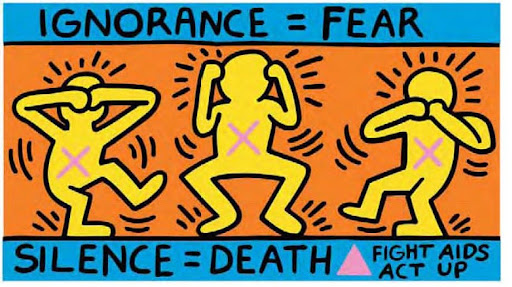
The artist they were focusing on was Keith Haring, a social activist artist known for his pop art style. His art often depicts sexual and social matters such as AIDS and queer identity.
During this assignment, students were directed to Keith Haring’s official website. When a parent was checking through one of the student’s school authorized computers, they were shocked to see depictions of male sexual reproduction organs as well as other sexual depictions.
The parents immediately filed for a court hearing.
They demanded that the school should be responsible for their child’s ongoing therapy to deal with their “traumatic experience”. Among their list of demands was that schools should also be responsible for contacting the student’s parents prior to showing such depictions, similar to the sexual education classes that students are mandated to take.
The art teacher resigned from her role, instead pursuing a job as an English teacher instead.
It is an era of art where artists are often pushing the definition of art, with artists such as Yves Klein with the color blue and Damian Hirst with his taxidermist depictions of death.
Nudity has been a prevalent subject of art for centuries, with the very defining culture of Western European art taking inspiration from their Greek and Roman ancestors.
According to Mr. Chertkow, an art teacher on campus, the Greeks viewed the “perfect human form as an example of the divine” and that they worked out the specific ratios that added up to the perfect form.
The Renaissance, which marked the reawakening of Western Europe and is most recognized as an era of scientific thought and artistic expression, drew inspiration from the Greeks.
Mr. Chertkow explained that Western Europeans “felt that that [the Greeks] was the pinnacle of society and of art”
Naturally the Renaissance would reflect the Greek anatomical precision. Artists that society respected and the names associated with the Renaissance; Leonard Da Vinci, Michelangelo, Caravaggio, all proved to be masters of imitating reality with paint.
They were especially known for their realistic renditions of the human body.
This view of the human body as something holy greatly contrasts with the twisted view modern society has of the human form as something immoral. Something that should be covered up under fabric, the more luxurious the fabric the better.
However the modern view of nudity is not entirely due to modern norms with the expectation to cover up, only showing skin if there are rippling muscles.
This discomfort is not new. The Romans, who followed the Greeks and were greatly influenced by the Greek artistic obsession with anatomy, were more conservative with nudity.
They would often place fig leaves to cover up the private parts of their works, sparing the viewer as well as the subject of their shame.
Keith Haring, whose art was deeply intertwined with his reality, produced pieces of pop art that served as both activism as well as cultural commentary.
He was quoted to have said “My life is my art, it’s intertwined. When AIDS became a reality in terms of my life, it started becoming a subject in my paintings. The more it affected my life, the more it affected my work.”
Haring would warp the human form into his distinctive pop art style as a way of spreading activism about AIDS and practicing safe sex as well as prodding the cultural view of homosexuality.
For the Greeks, nudity was associated with the divine. For Keith Haring, nudity was a method of activism to speak about his life experiences.
However, over the eras of art, the meaning of the nude human form has eroded into something that should be labeled as 18+.
Pornography was meant to feed fetishes, to arouse. Keith Haring was drawing from his experiences, to confront.