
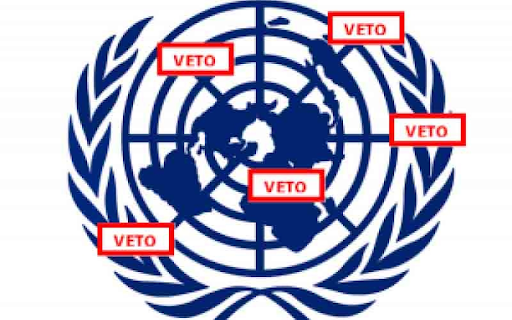
Why bother when the hard work of so many can be ruined by one vote? Veto power is a process by which a president, representative, or group of representatives of an organization can cancel a legislative bill with the power of one vote.
In the UN (United Nations), the veto power is granted to the five permanent seats on the council, which include the following countries: the United States, Russia, China, France, and the United Kingdom, with ten non-permanent seats that have no veto power and are rotated in by election.
Since the authority of veto is given to these countries, even if all the other countries hold a majority vote, it does not matter as long as one of these five countries opposes the legislation.
Countless times since the beginning of the Israel-Palestine war, peace and ceasefire have been common subjects for the council. Countries have long debated the topics of war crimes being committed during the war and whether there should be an intervention to save the innocent families from the cruelty of war.
Ever since the Israel-Palestine conflict reached a breaking point on October 7, 2023, when Hamas fighters killed about 1,200 people in Israel and took 251 hostages after years of oppression, the U.S. has been consistently documented vetoing against peace and permanent ceasefires. On the 10,000th meeting since 1946, held by the council to discuss the conflict once again, it was documented that the U.S. has vetoed peace and an end to famine at least six times throughout history.
According to the official UN News website, Morgan Ortagus, a representative of the United States at the 10,000th meeting of the Council on the situation in the Gaza, reported, “Washington’s opposition to the resolution ‘will come as no surprise’ as it fails to condemn Hamas or recognize Israel’s right to defend itself. The text also ‘wrongly legitimizes the false narratives benefiting Hamas, which have sadly found currency in this Council. This resolution also refuses to acknowledge and seeks to return to a failed system that has allowed Hamas to enrich and strengthen itself at the expense of civilians in need.”
Based on what Morgan Ortagus stated, the U.S. has no intention of harboring peace between the countries in the Middle East aside from aiding Israel and the complete abolition of Palestine so long as it recognizes Israel’s “right to defend itself”. UN News also has documented that in June of 2025, approximately 149 countries voted for a ceasefire and peace between Israel and Palestine. Only one voted no–the United States of America.
As tensions between Israel, the United States, and Iran continue to rise, students on campus have also begun to commonly debate possible solutions to the war. Freshman Isabella Favela added her opinion to the matter as she said, “I think the people need to work together more to create platforms where others can fundraise and donate, making sure that 100% of it goes to people in need. People should share their opinions and voices on more than just TikTok and gather others to do the same in order to send a big enough message and gather more that can help. As citizens, we aren’t as involved in our county’s decision-making, and I think that if only more people would stand up and get together, that message could reach someone in a position where they could make better decisions. I don’t think war is a good way to go about things.”
Aside from the Israel-Palestine conflict, the veto power has also been used questionably many other times throughout history. According to the United Nations Digital Library System, in December 2021, the UN council passed a resolution titled “Resolution 76/166”, which recognized food as a basic human right for all.
Food has historically been a controversial topic when it comes to basic fundamental human rights amongst countries. Despite it being internationally recognized as a right since the 1948 Universal Declaration of Human Rights and the 1966 Covenant on Economic, Social, and Cultural Rights, two countries have historically been against it.
About 186 countries were in favor of this legislation being passed. However, only two countries in the entirety of the United Nations famously voted against this resolution–the United States and Israel.
The U.S. Mission to International Organizations in Geneva contains information regarding the reasons behind the United States’ vote against basic human rights. “The resolution before us today rightfully acknowledges the calamity facing millions of people and importantly, calls on states to support the United Nations’ emergency humanitarian appeal. However, the resolution also contains many unbalanced, inaccurate, and unwise provisions that the United States cannot support. This resolution does not articulate meaningful solutions for preventing hunger and malnutrition or avoiding its devastating consequences. This resolution distracts attention from important and relevant challenges that contribute significantly to the recurring state of regional food insecurity, including endemic conflict, and the lack of strong governing institutions. Instead, this resolution contains problematic, inappropriate language that does not belong in a resolution focused on human rights.”
In summary, the U.S. chose not to recognize the right to food as a legally enforceable human right under international law because the resolution “inappropriately focuses on issues such as food sovereignty, technology transfer, and pesticide regulation rather than actionable solutions.” The website also states that the U.S. was particularly worried about food becoming a fundamental human right because it would disrupt global trade policies.
Individuals worldwide have taken these statistics to heart and attempted to uncover the truth behind Israel and the United States’ votes against food being a fundamental human right.
At Los Osos, a student who wishes to be anonymous added their own perspective and said, “I certainly do agree that food should be a fundamental human right. It’s horrible that restaurants and places mass-produce food items that not even their own employees can eat at the end of the day. It’s selfish and greedy and should be illegal to waste as much food as we do when there are people starving on the streets. It should be a basic human right to be able to eat, maybe not the best, most expensive foods, but a basic meal in order not to starve should be a right. It seems like the only reason some countries oppose it is because of the economy, like how huge corporations would be “losing” money, but it’s just greed, considering that most goes to waste.”
Whether the topic is fundamental human rights or global wars, one thing is for certain–as long as the veto power remains in the hands of only five countries, progress towards peace worldwide will never move forward.