
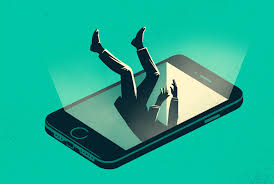
Whenever I see the phrase, “The chronically online will become the new underclass”, it makes me worried, because I know so many people who would be affected by it, especially teenagers. Social media is a strong part of the everyday lives of many teenagers. With businesses, colleges, friends, locations, government agencies, school groups, and clubs all being available on social media, it feels necessary to engage with it.
This exists alongside the online and offline conversations about the possible effects of being on social media, and peoples’ experiences while they are using it. Doomscrolling, bedrotting, and being ragebaited are some of the behaviors that people laugh about with others, or say that they are doing with their head down. People know it’s bad, but often don’t have the full context of why being on social media is so hurtful, or why these experiences occur, and what the effects are. Even if people develop habits and tricks to stop these behaviors, without the full picture, they are still susceptible to the harms of social media.
DJ Magic seeked to curb this. In late December of last year, they released a video on their YouTube, @yagirldjmagic, explaining their theory of digital pollution. They describe social media as an environment filled with pollutants: echo chambers, anxiety, overconsumption, cultural extraction (cultural appropriation), addiction, and rage bait. In their video, they discuss each of these pollutants and how they function in the digital space, hurting peoples’ abilities to create connections, mental wellness, and have necessities like time and attention.
With the help of Cal Newport’s video, “Why Smart People Are Abandoning Social Media | Cal Newport”, they explain that tech entrepreneurs designed the app with these pollutants and consequences as features, not just an adverse side effect like the bad taste of medicine.
These features, one of them being addiction, make the user extremely reliant on social media to craft their sense of self and meaning for life. This is incredibly dangerous when the goal of these entrepreneurs is to make money and have no problem poisoning the lives of the users to do so. We see this through discriminatory and ad-filled algorithms that seek to influence opinions or sell products. This is especially dangerous in a country like the United States that is quickly abandoning intellectualism and genuine learning or critical thinking for the self of any kind.
These destructive effects are built into the apps and are meant to weaken the user to make them more reliant on social media for a feel-good boost. Distracting from the intended harm of the tech manufacturers also seeks to individualize the issue, and blame the individual user for a system that is working against them.
They argue that people who are chronically online will become the new underclass because they will be addicted to the benefits of social media. It is everything that I mentioned earlier, but also includes the benefits of fame and money for influencers. These influencers and ordinary users who are addicted to social media will be trapped in the apps. People could also be trapped in the apps because it’s not accessible to leave.
Many people who use social media habitually do so because it is an escape. It is free, has diverse users, and is private if someone has their own account. For young and other marginalized people who have less access to cars, money, and freedom, social media is an optimal place for someone to enjoy themself. For this, Magic emphasizes that the community we build offline has to be inclusive of people who need the accessibility of social media before a digital caste is formed.
By calling social media a polluted environment, I believe that Magic provides a fuller picture of the situation, and gives us a stronger foundation to fight our way out of it. Their pollutants encompasses and explains the experiences of doomscrolling, bedrotting, and being ragebaited. It lets frustrated social media users know that they are not alone, and that all of us, especially the younger generation, are united in being manipulated by tech entrepreneurs, and can take back our power.
To solve the issue, Magic believes that we need to abandon social media because the only way to change it would be mass transformation of behavior on the app. They say that this is impossible to create in an app that still places profit over people, and says that we need to just leave the app and focus on building community in real life through methods like strengthening relationships and throwing events.
Since Magic’s video was released, I have seen multiple creators use their phrase, “the chronically online will become a new underclass” to echo that the digital space is toxic and we need to divest. If we do not, Magic and others warn of a digital future where we’re more controlled by tech billionaires and even more incapable to lead our lives ourselves because of our lack of necessities like true belonging, attention spans, and confidence.
At the end of the video, they remind watchers that abandoning social media will be “a deliberate process”, and a difficult one that has taken them over five months.
Sophomore Eli Shimmin has been off of social media for the same amount of time as Magic. He said, “It’s been really refreshing. I feel more energized. I feel less held back and affected by other peoples’ feelings and opinions, and stopped comparing myself too much.”
I hope that others will take up this call to turn these sites of exploitation and emotional manipulation into sites of silence, while our offline communities shout with real community and power. I strongly suggest that you watch the entirety of the 38-minute video to learn more about this topic for yourself.