
Two hundred years ago, the French Emperor Napoleon Bonaparte had written in a letter during his exile, “I found the French crown in the gutter. I picked it up, and the people put it on my head.”
On Sunday, October 19, the crown of Empress Eugenie III, wife of Napoleon III, was found shattered in the sewer on the streets of Paris following the Louvre heist that was carried out in broad daylight by a professional group of seven individuals.
According to the Parisian police, a group of individuals arrived at 9:30 a.m. local time in a vehicle equipped with a mechanical lift. When two of the thieves broke the window and entered the Galerie d’Apollon, where priceless crown jewels from various periods of French history are housed.
The collection was said to be especially treasured by King Louis XIV, a French king known for his extravagant lifestyle, with precious jewels carved from high–value minerals like lapis lazuli, amethyst, and agate.
Besides jewel-encrusted brooches, necklaces, and earrings, the thieves also left with Marie Louise’s sapphire and emerald jewelry sets, as well as the tiara and coronation crown of Empress Eugenie.
Security footage showed the gang of seven thieves “calmly” making their way to the glass display cases and smashing the display cases full of jewels, threatening museum staff and security with various power tools such as an angle grinder.
The guards evacuated the site and, despite the chaos and confusion, nobody was physically harmed.
By 9:38 a.m., the thieves had already made their escape on scooters.
All of the treasures have an estimated value of over 102 million dollars, but, according to Interior Manager Laurent Nuñez, the goods were “of immeasurable heritage value”.
The theft has stirred many cries on different ends of the emotional spectrum, At a press conference, French President Emmanuel Macron said, “The theft committed at the Louvre is an attack on a heritage that we cherish because it is our history,” whereas National Rally leader, a prominent leader of a social movement, Jordan Bardella called it “an intolerable humiliation”.
Officials speculate that, since the jewels are so recognizable, the thieves will likely dismantle them and melt down the gold and silver.
Netizens online have taken to various forms of protest. When Interpol added the stolen jewels to its Stolen Works of Art Database on October 21, two days after the incident, social media platforms were flooded with posts revolving around the situation.
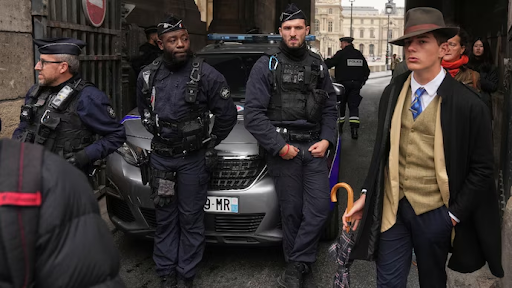
Memes made frequent appearances. A photo taken at the crime scene of a man went viral immediately.
The man was dressed in a gold three-piece suit, fedora, and using an umbrella as a walking stick immediately drew comparisons to the pop culture character Inspector Clouseau, the French equivalent of the Sherlock Holmes of the francophone world.
Although it was later revealed that the man had no connection to the Louvre robbery, netizens seized the image to portray a situation that they believed was absurd.
While French officials call it a “humiliation”, some people call it “the heist of the century”. A user on Instagram said, “The drama! The intrigue! The style!”
Two of the suspects were apprehended six days after the initial heist; one attempted to board an airplane to Algeria at the Paris Charles de Gaulle airport, and two others remain at large. The jewels have yet to be recovered.
Many believes it is a heist befitting an action movie with a touch of comedy, the Louvre robbery has left officials stunned and the world eagerly waiting for the whereabouts of the rest of the thieves who pulled off “the heist of the century”.