
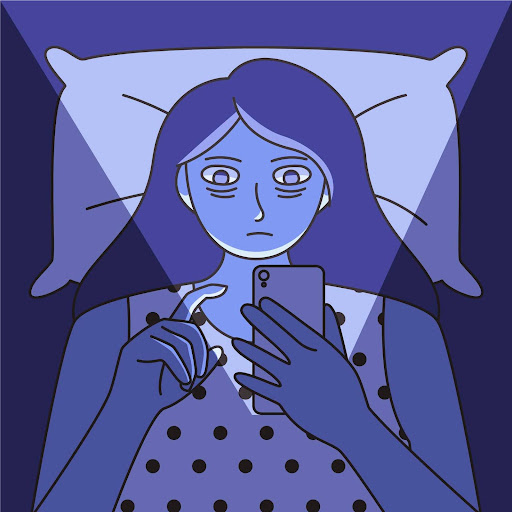
When life gets hard, some people turn to an escape: lying in bed doing nothing.
Especially for students, the stress and pressure of classes, homework, and exams often becomes overwhelming.
This can cause them to choose to enter the safety of their beds, endlessly scrolling or binge-watching television shows.
“Bedrotting”, a term created by Generation Z (Gen-Z) on social media, describes the act of laying in bed doing unproductive activities for hours, or even days, at a time.
It is when individuals choose isolation and their bed instead of socializing, exercising, or anything productive.
Bedrotting includes scrolling on social media, binge-watching television shows, mindless snacking, or even reading. These activities alone may not be dangerous, however. The defining aspect of bedrotting is that the individual spends extensive periods of time laying down, under the covers of their bed, inactive. Some may even neglect their hygiene or meals due to bedrotting.
Bedrotting has become somewhat of a trend, with many individuals promoting it and normalizing it on social media.
They advertise it as a form of self care, as if getting sucked into a bed will somehow help one’s mental health.
Unfortunately, bedrotting has become our generation’s way of decompressing and taking a mental break from life.
Because so many people engage in bedrotting, there is a misconception that bedrotting is normal and healthy, that it is a form of self care that is as fruitful as other forms of self care like exercise or meditation.
This couldn’t be further from the truth.
There are so many negative effects of bedrotting that teenagers are unaware of, things that go beyond simple laziness.
The seemingly innocent act of bedrotting can actually have detrimental effects on physical health and mental health.
Even though excessive amounts of time is spent in bed for individuals who bedrot, being online for long periods of time can hinder sleep due to the blue light from electronic devices.
This leads to sleep deprivation, and, ironically, an individual who is tired after spending days in bed.
Additionally, being inactive for long periods of time can lead to other health issues such as obesity and cardiovascular disease. On top of this, physical inactivity is linked to mood changes, depression, and other mental health issues.
Studies show that bedrotting can actually be an indication of mental health issues such as depression and anxiety.
Avoiding, procrastinating, and ignoring real-life issues by bedrotting can, contrary to popular belief, heighten feelings of anxiety.
To be clear, scrolling on social media for small periods of time is perfectly okay. Doing so can help decompress and lessen anxiety. It becomes a problem when we are unable to pull ourselves away from our devices, when we become tied to our beds.
We need to recognize that there are so many healthier, more proactive alternatives to bedrotting. If the goal is improving mental health, exercise, socializing with friends, meditating, cooking, journaling, and other activities are better choices.
Teenagers need to realize that ultimately bedrotting is not normal. Lying in bed unproductively will not help mental health and is not a form of self care.