
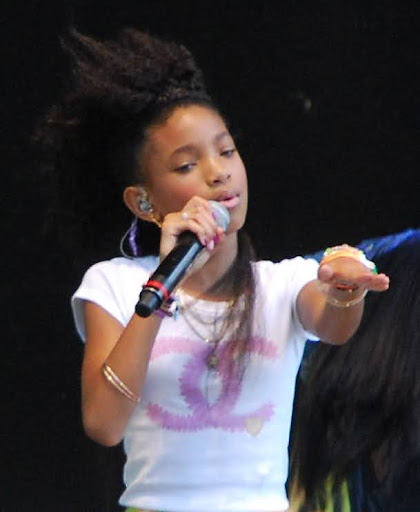
“Through our lines of life/ You recover the knowledge/ Hidden within our bodies and inside Earth herself/ To raise our brothers and sisters to a new state of consciousness”. On December 11, 2015, the music artist WILLOW released its first album “ARDIPITHECUS”. At the album’s 10th anniversary this year, it remains a capsule of spiritual knowledge from the then-14-year-old who has never stopped learning and sharing.
WILLOW uses it/its pronouns. The alternative album holds 15 tracks; it wrote 14 of them, and produced 13, showing a rare authenticity in the album since it is the primary creator.
In the songs, WILLOW deliberates new ways of being that are informed by spirituality and connection with the Universe. It aligns with the title of the album, “ARDIPITHECUS”. According to an Instagram post WILLOW published this year, Ardipithecus is an early form of the human from when “evolution” was “experimenting” with factors like social life and diet. This emphasizes how forces of the universe influence human ways of being. An influence that WILLOW likely wishes humans embraced more and learned from.
WILLOW is aware of how humans’ creations are harming them. The album begins with a hatred of the “Organization & Classification” that its generation is preoccupied with, imposing stereotypes and conformity. This phenomenon is greatly sustained by hierarchical systems like capitalism and racism that categorize people and force them to fit into stereotypes and conformity to keep the systems alive.
I found a possible mention of capitalism in another place in the album, hinting that WILLOW’s music was made with the system in mind. The song “Marceline” is dedicated to the character Marceline the Vampire Queen from Adventure Time. The end of the song is about how contemporary culture devalues people. It finished the song, sadly singing “Marceline, you’re breathing in gasoline”.
Gasoline is the fifth-largest industry in the world at over four trillion dollars. It is known for the exploitation of the Earth, the people mining the oil, and people’s neighborhoods, causing poor air quality and serious medical conditions. WILLOW mentions it as a cause of turmoil, linking its critiques of harm with the systems that allow it to happen.
The album’s critique of oppressive systems and its hierarchy makes it a piece for justice, and more enjoyable.
Another hierarchy WILLOW speaks about is age. In “Organization & Classification”, it laments its subjugation as people treat it as “just a teenager”. The artist also talks about struggles that teenagers often face, like not being accepted by their peers. In “IDK”, WILLOW relies on spirituality as an aid.
It wants to be open about its desire to be accepted, but also to “learn how to let go” of the desire. It says that in the learning process, they “don’t know” and acknowledge that in the mystery of the universe, there are some things they may never know. However, it aspires to keep learning and improving its life until it dies.
Throughout the album, WILLOW expands this solution to human relations at large. It proposes a realignment with spirituality to defeat prevalent disconnection and harm.
For itself and the others that take up this journey, it urges them to embrace rebellion. In “UR Town”, it urges listeners not to “sit home and believe” what others tell them and experience it themselves. “Waves of Nature” directs not to “spend so much time…tryin’ to classify wrong and right” and instead to “embrace the bumpy ride” of life. WILLOW also talks about the need for collectivity, saying “love and communion, there’s nothing better/ even in rough weather” in “Marceline”.
The beautiful album shows WILLOW’s sheer vulnerability as it explores its intimate thoughts at 14.
It has been beautiful to watch WILLOW grow throughout the years, and the artist has talked about how music has helped their personal development.
This illuminates that art is a necessity for personal growth, and despite its cruciality, it can be inaccessible. WILLOW’s perspective is rare and silenced as a person who is Black, young, and, as of 2025, polyamorous and uses neopronouns. But as the child of celebrities Will and Jayda Smith, WILLOW had access to music equipment and professional musicians through its financial and social position.
The lessons in the album also illuminate how much Black LGBTQ+ youth have to offer us. They often practice different ways of being in relation to the universe, themselves, and other people.
“ARDIPETHECUS” is a footprint in the trail and the gift of WILLOW. If you choose to listen, it can have much to offer you as you live and become.