
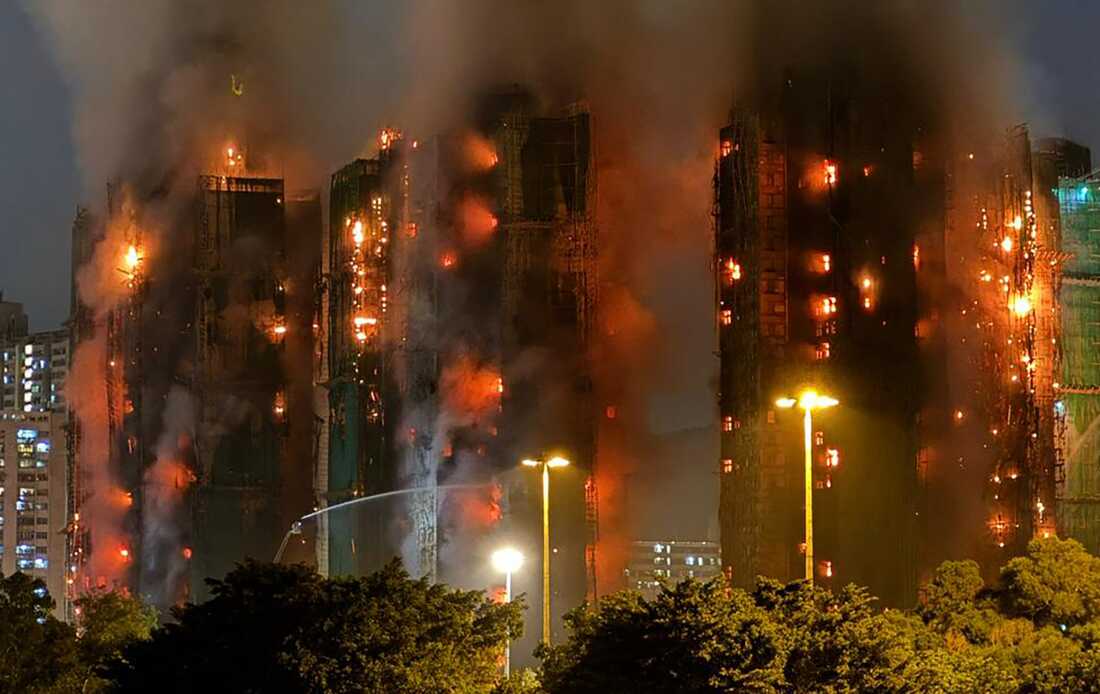
Hong Kong, a busy-ful city in China, has recently been engulfed in flames so hot that it has become known as one of the deadliest fires Hong Kong has witnessed in the past century. This large fire broke out at the Wang Fuk Court apartment complex in Tai Po District, New Territories, Hong Kong. The flames burned intensely for more than twenty-four hours, with 2,000 firefighters having to work for two full days to extinguish it, later being declared a Level 5 fire, with the heat preventing firefighters from entering the buildings at times, mainly killing the people in those apartment complexes.
In the course of the fire, the identities of 120 out of the 160 dead have been verified via DNA or a fingerprint test. Police said they have completed a search for bodies inside all seven of the eight high-rise residential towers destroyed in the flames that initially broke out. However, 30 people were still reported missing. The youngest person who died in the fire was a 1-year-old infant while the oldest was 97 years old.
While the hunt for victims through the piles of fallen bamboo continues, police and the city’s anti-corruption body said that they had arrested 15 people as authorities have checked the possible corruption and negligence of renovation work. Substandard plastic nylon netting sheeting scaffoldings went up outside the towers, and foam boards installed on windows were discovered to have helped the fire’s rapid spread.
Moreover, both residents and officials have come to say that some fire alarms in the buildings had failed to sound when the fire began, though it was not exactly clear how much the fire had spread, the problem remained within the complex.
Police said that six people who allegedly deactivated a couple of fire alarms at the housing complex during the renovation works were arrested as they were suspiciously making false representations to the fire services department. While exactly how the fire started is still under continuous investigation, the government seems to have raised concerns as having arrested a university student who demanded a more comprehensive investigation. Additionally, some volunteers have faced intimidation from the government-led community service corps. These actions have highlighted a governing approach shaped mainly by political risk mitigation rather than public administration.
On the other hand, Hong Kong residents have responded by making white flowers at makeshift shrines with messages of support posted in public squares, along with a rainbow of paper cranes to try to deal with the massive loss their community has faced. Moreover, Hong Kong’s community of artists have also responded to the trade with works of art, film, and literature. However, these artists have also been dismayed—those with track records of activism and political activity have been prevented from exhibiting—theatre groups find their venue bookings cancelled harshly.
When asked how exactly they would support the victims of the tragedy that took place, an anonymous senior said, “I would make art with messages of focusing on the victims themselves of the fire instead of the destruction itself, urging them to get more support with housing and overall mental health.”
While Hong Kong was once a lively city, often boisterous with public debate—the city has now fallen silent despite how badly it has affected so many people’s relationships and homes. Whether it’s because of the government or grief—many artists and journalists have been shushed while attempting to discuss the recent tragedy.
When asked what he thought should be done to support survivors and victims, Angelo Tan, a junior, said, “The government can provide housing and financial support as well as temporary homes while rebuilding the apartment complexes”.
Overall, the situation currently in the heart of Hong Kong is terrifying, as reports of corruption or regulatory failures have been noted as a factor in the fire, causing more confusion. Despite this, Hong Kong continues to recover bodies from the ashes of the fire and attempts to bring some peace to their loved ones while also rebuilding their community one step at a time.