
TW: Feminism
The art history world is heavily dominated by European males- it is an undeniable fact, regardless of how familiar you are with art.
The way art history has been taught to us- from the names to the eras- has been largely dictated, astoundingly, by a European man.
Giorgio Vasari is credited with being the first to historically document artists with his revolutionary book, “The Lives of the Most Excellent Painters, Sculptors, and Architects”.
With this book, Vasari not only set the canon of art history, but he also dictated what it took to become an artist. His standards heavily influenced art academies throughout Europe, as well as the Salon in Paris, an annual exhibit with an annual showing of artistic talents that is notorious for being highly selective.
The institutions were heavily misogynistic, outrightly not allowing women to attend their classes and strictly limiting the showing of their pieces.
While there have been few exceptions of women claiming a spot in the canon of art history such as Baroque painter Artemesia Gentilleschi who was viewed as a contemporary of the far more illustrious Caravaggio and Élisabeth Louise Vigée Le Brun who was the official portraitist of the controversial Queen Marie Antoinette, they were often dismissed instead as the muse rather than the artist- a history that can be traced to the Nine Muses in Ancient Greek mythology who ruled over their unique artistic realms.
However, even in modern times, the art world is still largely dominated by a Eurocentric male view. From the lack of representation of arts by other cultures to the absence of art by women and people of color, it is difficult to claim that art has become more inclusive over the centuries.
History books still seem to refuse to add a space in the modern history section for a fully clothed woman or a subject with a different skin pallor than the books are familiar with.
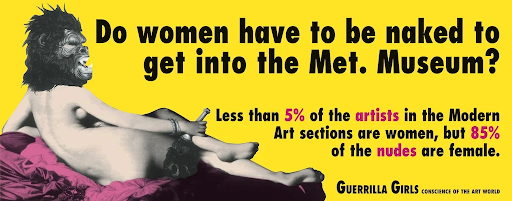
The Guerrilla Girls stand against the monotonous canon written in 12px Times New Roman Font with bright neon signs that hold letters, bluntly challenging the pillars of the art world.
Their works, often in the form of posters, banners, and protests, aim “to expose gender and ethnic bias and corruption in art, film, politics and pop culture,” according to their website, with satire layered over cold, hard facts and statistics.
The frustrations are shared by a member of the Feminology club, a feminist club on campus, one who wishes to remain anonymous. She said that “it’s frustrating to see that we still have a loooonggg way to go before we [as women] are respected as people rather than what ‘assets’ we have or how conventionally attractive we are rather than being taken seriously for our minds or our creativity.”
Challenging these issues since 1985, the group of anonymous women artists has been around the world in major art cities such as Paris, Hong Kong, and New York City, and made their mark in art institutes by downright challenging them.
Celebrating their fortieth anniversary in 2025, the Guerrilla Girls have shifted the question that had nervously been whispered of “Are women underrepresented?” to “Who chooses to censure women and artists of color for their own benefits?”
From the iconic Guerrilla Girls 1989 MoMA (Museum of Modern Art) poster in their characteristically bold and sharp humor that announced the immense difference between how women artists were represented and the representation of women in art to now, their efforts have clearly paid off.
With their bold posters and billboards at their public protests before major museums, the Guerrilla Girls still exist today.
They adapt pseudonyms and refer to each other by the names of influential female figures such as Frida Kahlo and Gertrude Stein. They intend to remain anonymous as they believe that their work should be the focus rather than their identities.
Slowly, their posters began to announce their success in statistics as museum exhibits became more inclusive, as they were forced to confront their own discrimination.
Museums such as the Met, MoMA, the Whitney, and the Venice Biennale responded to the Guerrilla Girls’ efforts by publicizing diversity statistics, increasing exhibitions showing women and artists of color, among other actions.
Some of their activism pieces have been featured in modern art museum exhibits, as they should.
Their work has finally prompted people to ask the right questions and pivot the attention of art historians from the names repeated in numerous editions of textbooks to a more modern and accurate depiction of artists.
As an aspiring art historian myself, the Guerrilla Girls are inspiring figures to me. Their artistic expression of their values reminds me that art is not simply meant to be eye candy, as is also the case with women, but also as a powerful form of speech.
Throughout history, artists have searched for ways to speak their truth by layering it into beauty, and it is because of these people that people like the Guerrilla Girls can tell their truth in bold neon signs.
It reminds me that while the slots of the past canon of art history have already been filled and set in stone, the stage of contemporary art has barely been occupied.
It’s high time that women had a place in the canon.